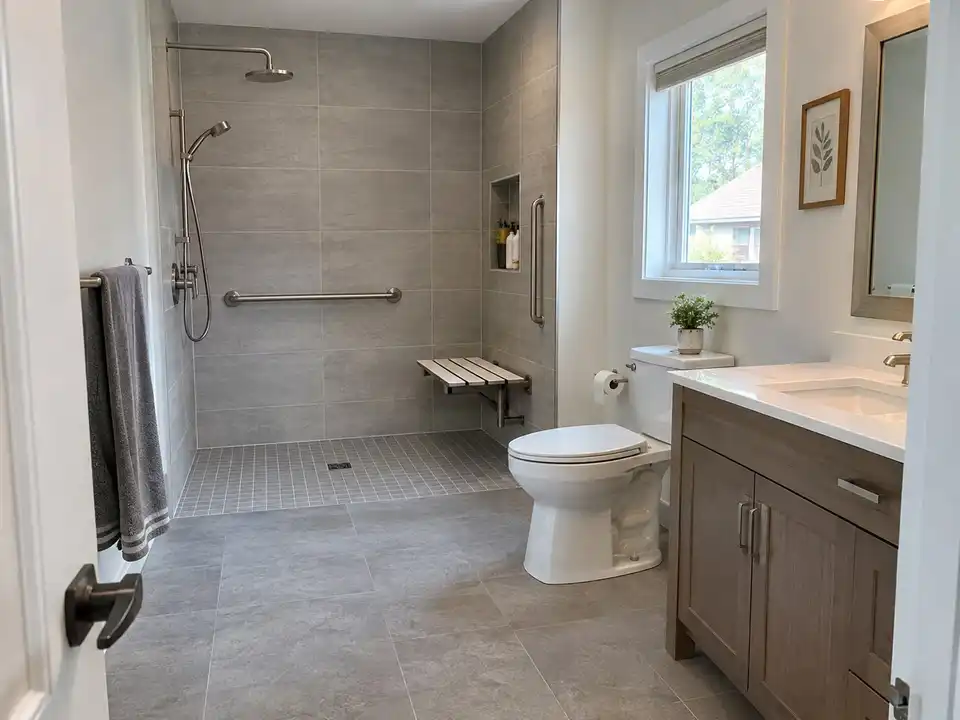
A home renovation in Milton, such as a main-floor bathroom, a stair lift or a ramp at the front door, is often what lets you stay in your home for years longer. For homeowners 55+, the value already in the house can pay for it, with no required monthly mortgage payments.
Which renovations help you stay in your home?
The jobs that matter most make stairs and bathrooms safer:
- A main-floor bathroom with a walk-in shower and grab bars
- A stair lift, or a main-floor bedroom so you can stop climbing stairs
- A ramp, wider doorways or a side entrance with no step
- A suite for family or a caregiver, so help lives close by
Most Milton homes are fairly new. Statistics Canada’s 2021 Census (May 2021) found only 18.9% of Milton homes were built before 1981, and 73% were built in 2001 or later. In a newer house the work is often about layout: getting a full bathroom and a bedroom onto the main floor.
In older parts of town, such as Old Milton, the house itself may need work first. That matters for approval, as the section on your home’s condition explains below.
What does a Milton building permit cost?
The Town of Milton says you need a building permit before any construction or renovation begins. Its fee schedule (October 2026) includes:
- Interior alterations: $6.55 per square metre, minimum $264.20
- New plumbing or changes to plumbing: $264.20
- A new door opening or side entrance: $264.20
- An unenclosed deck or porch: $163.11
- An addition: $25.13 per square metre, minimum $264.20
The Town doesn’t say whether small jobs such as grab bars or a stair lift need a permit. Ask its building department before work starts.
Can you add a suite for family or a caregiver?
Yes, in many cases. Milton calls these additional residential units (ARUs): a basement apartment, a unit inside the house, or a garden suite or coach house out back.
On an urban lot with municipal water and sewer and a detached house, semi or townhouse, you can have up to four units, including your own home. Only one of them can be in a separate building (Town of Milton, October 2026).
Every ARU must be registered with the Town, including one a family member lives in and one that already exists. Registration costs $340 per unit and includes a short fire and by-law inspection. It renews every year, with no renewal fee during the Town’s three-year pilot.
A building permit is also needed: $9.58 per square metre for a unit attached to the house, or $25.13 for a detached one, minimum $264.20 either way.
Rural Milton got its own ARU rules in January 2026. Many rural lots can now add one unit, with tighter limits inside the Niagara Escarpment Plan Area and none in the Greenbelt Natural Heritage System. Rural Milton and Campbellville has more on country properties.
The federal Multigenerational Home Renovation Tax Credit is refundable. It applies to up to $50,000 of qualifying costs to build a self-contained unit so a relative 65 or older, or an adult eligible for the disability tax credit, can live with family (Canada Revenue Agency, October 2026).
Help from Halton Region and the federal government
Halton Region raised its basement flooding subsidies in September 2025, for work done after July 15, 2024:
- Downspout disconnection: 100% of the cost, up to $900
- Backwater valve: 50%, up to $1,600
- Weeping tile disconnection and sump pump: 100%, up to $6,500
- Sewer lateral lining or repair: 50%, up to $4,000
Halton also offers a free household drainage survey for homes built from the mid-1950s to the late 1970s that have flooded before and sit in a priority area.
For accessibility work, the federal Home Accessibility Tax Credit covers up to $20,000 of eligible costs per year per home, for someone 65 or older at year end or eligible for the disability tax credit (Canada Revenue Agency, October 2026). For 2026 the credit is 14% of those costs, so it’s worth up to $2,800 (Department of Finance Canada, June 2026).
How a reverse mortgage pays for the renovation
Nothing is due on a reverse mortgage each month. Your tax, insurance and upkeep carry on as before, and the interest is added to what you owe. A well-kept house usually grows in value too, and that growth stays yours.
The money usually comes as a lump sum at closing, ready for the contractor’s deposit and the bills that follow. Some lenders also let you take more later, at a rate or fee that varies by lender.
The most you can borrow isn’t extra money
The most you qualify for is a ceiling on the whole mortgage. It doesn’t sit on top of what you already owe. Anything still owing on the home is paid off first, at closing.
Say a Milton homeowner, 75, owns a freehold townhouse worth the TRREB September 2026 benchmark of $603,200, and still owes $90,000 on her mortgage. These numbers are an illustration, not a quote.
- Most she could borrow at 75: about $348,000
- Minus her mortgage, paid off at closing: $90,000
- Left for the renovation and anything else: about $258,000, before one-time costs of about $2,000 to $3,500
Her contractor quotes $45,000 for a main-floor bathroom and a front ramp (an assumed figure for this example). She takes that amount. Interest is charged on the $90,000 that cleared her mortgage and the $45,000 for the work, not on the rest. Her old mortgage payment ends on closing day.
Your home’s condition is part of approval
An appraiser visits your home once and reports on its value and condition. A home in major disrepair can be turned down.
When a needed repair is already booked with a contractor, some lenders can build it in. They hold back part of the money and release it once the work is done. Richard checks how each lender handles your home before you apply.
Is a reverse mortgage the right way to pay for a renovation?
It suits some Milton homeowners and not others. Interest adds to the balance over the years, so the plan works best when you expect to stay in the home after the work is done. If your income is steady, a HELOC or refinance may also fit.
Start early. From application to money usually takes a few weeks, so it helps to start the estimate while you’re still collecting contractor quotes. The appraisal and your meeting with your own lawyer for independent legal advice both happen in that window.
Richard compares every reverse mortgage lender in Canada for your home, plus those other options. You get a recommendation based on your situation, even if it’s not a reverse mortgage. To see the ceiling for your own age and home value, use the Milton reverse mortgage calculator.
What you get from Richard
- Shows what's left after your current mortgage is paid off
- Matches the money to your renovation plans
- Explains how the appraiser looks at your home's condition
- Points you to the lenders that hold back money for booked repairs
- Compares all four reverse mortgage lenders for your home
- Looks at a HELOC or refinance when one could fit better
- Lists every one-time cost before you apply
- Copies your family on every email if you like