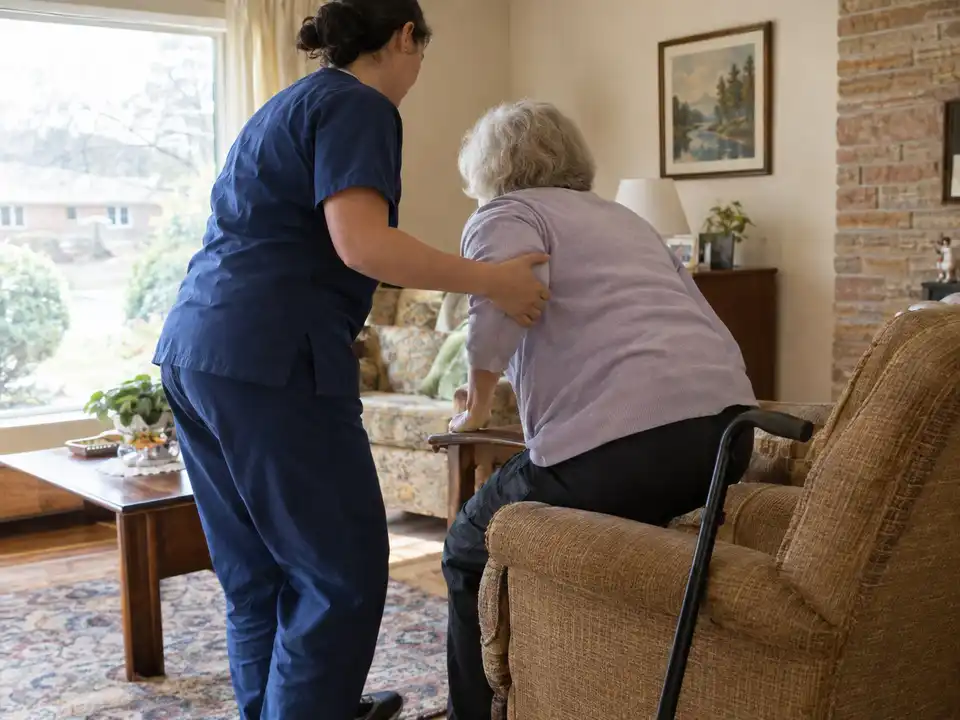
Home care in Milton usually comes from two places: publicly funded visits arranged through Ontario Health atHome, and private care you pay for yourself. When the private part grows, the value of your home can pay for it without a sale or a move.
Who arranges publicly funded home care in Milton?
Ontario Health atHome does. Milton is in its Mississauga Halton area, and it has an office in Milton, according to the Mississauga Halton Healthline directory (October 2026).
A care coordinator assesses what you need at home. The services can include nursing, personal support workers for bathing and dressing, physiotherapy, occupational therapy and social work, all covered by OHIP. Applications for long-term care go through the same care coordinators.
Start there, even if you expect to pay for some care yourself. The publicly funded hours come first, and private care fills whatever gap is left.
When publicly funded hours aren’t enough
The assessment sets how many hours of care you get. If you need more, such as extra personal support, overnight help, housekeeping or meals, you can hire it privately. That part is paid out of pocket.
To size the gap, write down the hours of care the coordinator approves, then the hours you actually need. Multiply the difference by the hourly rate a private agency quotes you. That’s roughly what monthly deposits would need to cover, and you never have to take more than that.
For many Milton homeowners, the money for it is already in the house. TRREB’s benchmark for a typical Milton home, all types combined, was $861,600 in September 2026.
How a reverse mortgage pays for home care
With a reverse mortgage, you borrow from the value of your Milton house and owe no monthly mortgage payment. Property tax, home insurance and upkeep stay yours. Interest is added to the loan. Your home’s value usually grows too, and that growth stays yours.
For care, the money can come to you in three ways:
- Monthly deposits into your bank account, to match the care bills as they arrive.
- A lump sum at closing, to keep for care, repairs or bills.
- Both: an amount at closing, then regular deposits after that.
Lenders may ask you to take a starting amount at closing, typically $20,000 to $25,000, and regular deposits typically start at about $1,000 a month (Financial Consumer Agency of Canada). Interest is charged only on money you’ve received.
The money is a loan, not income. It’s tax-free and has no effect on OAS or GIS.
What it could look like for a Milton home (illustrative)
Say a Milton widow, 80, owns a home worth the TRREB composite benchmark of $861,600, with no mortgage. These numbers are an example, not a quote.
At 78 and older, the most she could borrow is 60% of the home’s value, about $517,000. She takes $25,000 at closing to keep for extra costs. Then she arranges $2,000 a month for private personal support on top of her publicly funded visits.
After one year she has received $49,000. Interest is charged on that $49,000 only, not on the rest of what she qualified for. Her OAS and GIS stay the same.
Her daughter is copied on every email, so the whole family sees the same numbers and nobody has to relay them.
If her needs grow, she can ask for more within what she qualified for. Some lenders charge a small fee or a different rate on later amounts, which is one of the things Richard compares across all four lenders.
Keeping up the home while you receive care
A reverse mortgage asks three things of you while you live there: pay the property tax, keep the home insured and keep up basic upkeep. Those stay yours even when care takes most of your attention.
Milton’s 2026 residential tax rate is 0.865146% of your assessed value, so a home assessed at $600,000 pays about $5,191.34 for the year (Town of Milton, October 2026). You can size the monthly deposits to cover the tax bill too, so it never gets missed.
Halton Region also offers a property tax deferral for owners 65+ with combined owners’ income under $69,500. You can’t keep both, because a reverse mortgage pays off deferred tax when it closes. The Milton property tax guide compares the two.
What if one spouse needs long-term care?
If both spouses are borrowers and one moves to long-term care or dies, nothing changes for the one at home. There’s no repayment and no new approval.
Repayment is due only after a sale, a permanent move out by the last borrower, or that borrower’s death. A hospital stay or time in rehab is not a permanent move.
Long-term care has its own monthly cost. From July 1, 2026, the most a resident pays for a basic room is $2,129.17 a month, according to Ontario’s Paying for long-term care page (October 2026).
Beds are also scarce: Allendale, the Region-run home in Milton, had 583 people on its waiting list as of June 30, 2026, per the province’s long-term care finder. The long-term care in Milton guide covers both Milton homes and how to apply.
Milton supports that cost little or nothing
- Milton Seniors’ Activity Centre: run by the Town and on a Milton Transit route. Annual membership is $25 for ages 65 to 84 and free at 85 and older (Town of Milton, October 2026).
- Windrow removal: the Town clears the snow ridge a plow leaves at the end of your driveway, for residents 65+ or with a disability who have no able-bodied person 16 or older at home. It costs $71 for December 1 to March 31, and registration runs October 19 to 23, 2026 (Town of Milton, October 2026).
- Milton access+: Milton Transit’s specialized service for people with disabilities who can’t regularly use the conventional buses (Town of Milton, October 2026).
- Halton Region programs: adult day programs in Milton, Milton Place and Friends Landing, plus assisted living at Martin House in Milton (Halton Region, October 2026).
The Milton seniors’ services guide lists more local help.
Is a reverse mortgage the right way to pay for care?
It depends on how long you expect to need care, whether you want to stay in the home, and what savings or income you already have. Interest adds to the balance over the years. A permanent move into long-term care by the last borrower brings the mortgage due.
Richard compares every reverse mortgage lender in Canada for your home, and a HELOC when your income allows one. You get a recommendation based on your situation, even if it’s not a reverse mortgage. To see the most your home could provide at your age, try the Milton reverse mortgage calculator.
What you get from Richard
- Works out how much care your home's value could fund
- Sets up monthly deposits, a lump sum or both
- Shows why the money doesn't reduce your OAS or GIS
- Compares all four reverse mortgage lenders for your home
- Explains what happens if one spouse moves into care
- Copies your adult children on every email
- Works out what's left after the lawyer pays off your current mortgage
- Looks at a HELOC when it could suit you better